GEOTECHNICAL ENGINEERING
WICHITA
HomeSeismicSoil liquefaction analysis

Soil Liquefaction Analysis in Wichita: Protecting Your Structure on Questionable Ground

Rigorous testing. Clear reporting.

LEARN MORE

We see a recurring mistake with Wichita projects near the Arkansas River: the geotech report stops at a standard boring log without considering what happens when the saturated sandy soil shakes. In our region, the loose alluvial deposits underlying downtown and areas west toward the Big Ditch are prime candidates for seismic-induced strength loss. A deep foundation designed without a liquefaction analysis is a gamble. The 2014 magnitude 4.8 earthquake near Conway Springs was a wake-up call, reminding us that Kansas isn't immune to seismic events. We run the CPT test to capture continuous pore pressure data and pair it with SPT drilling for disturbed sampling, giving you a defensible evaluation of the cyclic stress ratio your site can handle before the ground turns to soup.

A site on loose alluvium with a shallow water table can lose over 50% of its bearing capacity in a design-level earthquake. The IBC requires you to prove it won't.
Our service areas

Our approach and scope

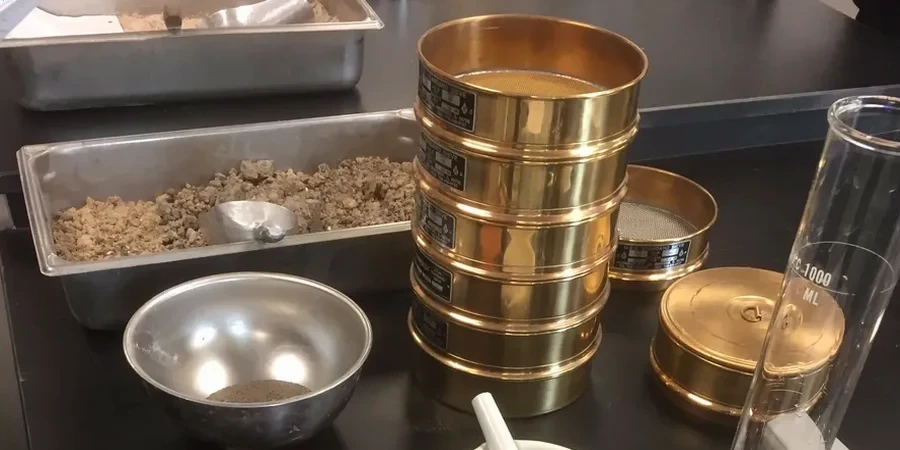
Picture a five-story mixed-use building proposed in the Delano District, close to the river. The boring logs show clean fine sand from 8 to 22 feet below grade, with the water table at 10 feet. Standard penetration test blow counts hover around 8. That combination of shallow groundwater, low relative density, and uniform gradation triggers a mandatory liquefaction screening under IBC Section 1803.5.12. Our analysis goes beyond the simplified Seed & Idriss procedure. We run sieve tests to check the coefficient of uniformity and apply site-specific ground motion parameters from the USGS hazard maps. When the factor of safety against liquefaction drops below 1.1, we don't just flag the problem—we help the structural engineer evaluate stone columns or rigid inclusion grids as mitigation alternatives.
Soil Liquefaction Analysis in Wichita: Protecting Your Structure on Questionable Ground
Technical reference — Wichita

Local considerations

East Wichita and the western floodplain tell two completely different stories. East of I-135, you're typically on stiff, overconsolidated shale and limestone residuum where liquefaction is a non-issue. West of the Arkansas River, especially around the Cargill salt plant and the industrial corridor, the soil profile shifts to 30 to 60 feet of loose Holocene alluvium. Borrow pits and old meander scars are hidden beneath warehouse slabs. We've seen projects where the geotechnical engineer assumed a dense sand layer at 25 feet, only to find a buried channel of loose, saturated silt during test pits excavation. Missing that lens means your settlement estimate after pore pressure dissipation could be off by inches—enough to shear utility connections and tilt floor slabs. The risk isn't just total collapse; it's differential movement that renders a building uninsurable.

Need a geotechnical assessment?

Reply within 24h.

Email: [email protected]

Reference standards

ASCE 7-22: Minimum Design Loads for Buildings and Other Structures, IBC 2021: Section 1803.5.12 Seismic Design Site Class and Liquefaction Assessment, ASTM D1586: Standard Test Method for Standard Penetration Test (SPT), ASTM D2487: Standard Practice for Classification of Soils for Engineering Purposes, Youd et al. (2001): Summary Report of the NCEER/NSF Workshops on Liquefaction Evaluation

Typical values

ParameterTypical value
Peak Ground Acceleration (PGA)Site-specific per USGS, mapped for Wichita 0.07-0.10g
Magnitude Scaling FactorCalculated per NCEER/NSF workshop recommendations
Standard Penetration Resistance (N1)60Corrected for overburden, energy ratio, and fines content per ASTM D1586
Cyclic Stress Ratio (CSR)Adjusted for depth, total and effective vertical stress
Cyclic Resistance Ratio (CRR)Derived from SPT or CPT correlations, modified for fines content
Factor of Safety against LiquefactionTarget >1.3 for critical structures per ASCE 7-22
Liquefaction Potential Index (LPI)Calculated for the upper 60 feet to estimate surface manifestation risk

Frequently asked questions

Is liquefaction really a concern in Wichita, Kansas?

Yes, particularly along the Arkansas River corridor. While the seismic hazard is moderate compared to California, the saturated loose alluvial sands in West Wichita can liquefy under a design-level earthquake. The IBC requires a liquefaction assessment for sites with Site Class E or F soils, which are common near the river.

What does a soil liquefaction analysis cost for a Wichita project?

A complete liquefaction analysis for a typical commercial building site in Wichita ranges from $2,900 to $3,960, depending on the number of borings and the depth of the potentially liquefiable layer. This includes field work, laboratory testing, and the engineering report with factor of safety calculations.

How deep do you need to investigate for liquefaction?

Per standard practice, we evaluate the upper 50 to 60 feet of soil. In Wichita, the liquefiable alluvium typically extends to 40 feet near the river, but we verify bedrock depth with at least one deep boring. Liquefaction below 60 feet rarely causes surface damage to shallow foundations.

What happens if my site fails the liquefaction screening?

A failed screening doesn't stop the project; it triggers a more detailed analysis and a discussion about mitigation. Options range from ground improvement (like stone columns or compaction grouting) to deep foundations that bypass the liquefiable layer, or structural design that accommodates the expected settlement and lateral spread.

Do you use only SPT data, or can you run a CPT as well?

We use both, and often combine them. The CPT provides a continuous profile of tip resistance and sleeve friction, which is excellent for identifying thin liquefiable lenses. SPT gives us a disturbed sample we can test in the lab for fines content and plasticity. The combined approach reduces uncertainty in the CRR correlation.

Location and service area

We serve projects in Wichita and surrounding areas.

View larger map