GEOTECHNICAL ENGINEERING
WICHITA
HomeSeismicBase isolation seismic design

Base Isolation Seismic Design for Wichita Structures

Rigorous testing. Clear reporting.

LEARN MORE

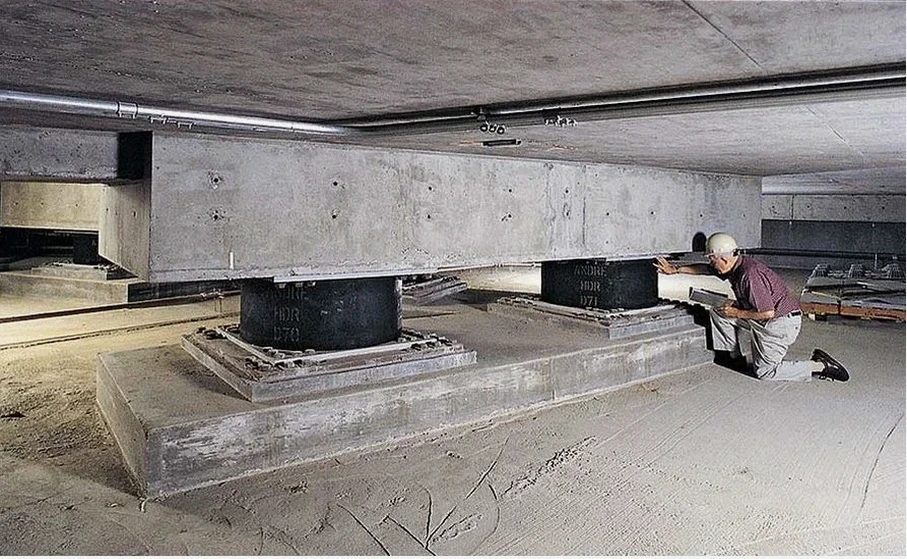
The lead-rubber bearing sitting on our lab bench right now came from a manufacturer testing program for a Wichita medical facility—and that's exactly the kind of hardware we evaluate before it goes under a building. Base isolation seismic design is not about making a structure stronger against shaking; it decouples the superstructure from ground motion entirely. In Wichita, where seismic hazard may be moderate but soil amplification on deep alluvial deposits is very real, the isolator properties must be tuned to the site. Our team handles the full characterization: input ground motions scaled to the ASCE 7 design spectrum for the Central U.S., hysteretic behavior of the isolation system, and verification against IBC performance criteria. We also run the supporting seismic refraction surveys when VS30 profiles are required by the geotechnical report, and we pair the dynamic analysis with CPT testing to capture the stratigraphy that controls basin amplification effects across the Arkansas River valley.

Base isolation in Wichita is as much about the soil column as it is about the hardware—miss the impedance contrast and the isolation period becomes ineffective.

Our service areas

Our approach and scope

Something we see repeatedly in Wichita: the upper 10 to 20 feet of soil profile is stiff lean clay, but below that the Wellington Formation can have interbedded shale and siltstone layers that create sharp impedance contrasts. That matters for base isolation design because the effective period of the isolated structure must stay well above the site period—if the impedance boundary sits at the wrong depth, the code-level spectrum can underestimate mid-period spectral accelerations. We address this by running site response analyses with measured shear wave velocities, not just generic NEHRP site class assumptions. When the structural engineer needs a complete picture, we also incorporate grain size analysis on samples from the bearing stratum and, for liquefaction-prone lenses, we bring in liquefaction assessment to rule out loss of bearing under the isolator pedestals. Wichita's seismic hazard is dominated by the Nemaha Ridge and the southern extension of the Humboldt Fault Zone, so the design basis earthquake selection has to reflect local seismotectonic reality, not just a default USGS deaggregation.
Base Isolation Seismic Design for Wichita Structures
Technical reference — Wichita

Local considerations

A six-story office building near the Arkansas River was designed with base isolators on a mat foundation, but the original geotechnical report used a generic Site Class D spectrum without measuring the deep shear wave velocity. When we ran a downhole seismic test to bedrock at roughly 90 feet, the actual VS30 came back at 220 m/s—borderline Site Class E. The site period shifted almost 0.4 seconds, pushing the isolation system closer to resonance with the soil column. The fix required re-tuning the isolator stiffness and increasing the displacement capacity of the moat wall. Wichita has pockets of soft alluvium along the river corridor, and assuming Site Class D everywhere is a gamble. Base isolation works brilliantly when the soil-structure interaction is quantified; skip the site-specific dynamic characterization and the isolators can amplify motion instead of reducing it.

Need a geotechnical assessment?

Reply within 24h.

Email: [email protected]

Reference standards

ASCE 7-22 Minimum Design Loads and Associated Criteria for Buildings and Other Structures, IBC 2024 International Building Code, ASTM D7400 Standard Test Methods for Downhole Seismic Testing, NEHRP Recommended Seismic Provisions for New Buildings and Other Structures, ASCE/SEI 41-23 Seismic Evaluation and Retrofit of Existing Buildings

Typical values

ParameterTypical value
Design basis earthquake (DBE) return period475 years (10% in 50 years)
Maximum considered earthquake (MCE) return period2,475 years (2% in 50 years)
Isolation period range verified2.5 – 4.0 seconds typical
Required VS30 site classificationPer ASCE 7-22 Chapter 20
Minimum isolator displacement capacity≥ DTM per ASCE 7-22 §17.5
Damping ratio in isolation system15% – 30% equivalent viscous
Bearing stratum compressive strength≥ 3,000 psf allowable (unfactored)
Relevant ASTM for elastomeric bearingsPer manufacturer QA program

Frequently asked questions

What is the typical cost range for a base isolation design study for a mid-rise building in Wichita?

For a commercial or institutional building in the Wichita area, a complete base isolation design package including site-specific ground motion development, isolator property specification, nonlinear time-history analysis, and a peer-review-ready report generally falls between US$4,510 and US$7,770, depending on the complexity of the subsurface conditions and the number of ground motion pairs required.

Does Wichita require base isolation under the current IBC?

Base isolation is not mandatory by code in Wichita for most occupancy categories, but it becomes a highly effective strategy for Risk Category III and IV structures—hospitals, emergency response facilities, and designated shelters—where the IBC requires enhanced performance objectives that are difficult to achieve with conventional fixed-base design alone.

How do the deep soil deposits along the Arkansas River affect isolator performance?

The alluvial deposits can amplify long-period ground motion, particularly in the 1.0 to 2.5 second range. If the isolation system period lands in that band, the displacement demand increases significantly. We always recommend a site response analysis with measured VS profiles along the river corridor to avoid underestimating spectral accelerations at the isolation period.

What geotechnical data do you need before starting the isolation design?

At minimum, we need a VS profile to at least 100 feet depth—preferably from a downhole seismic or MASW survey—along with standard borings for soil classification, Atterberg limits, and unconfined compressive strength on the bearing stratum. If liquefiable lenses are suspected, we also require SPT blow counts or CPT tip resistance data to evaluate bearing stability under the isolator pedestals.

Location and service area

We serve projects in Wichita and surrounding areas.

View larger map