GEOTECHNICAL ENGINEERING
WICHITA
HomeInvestigationExploratory test pit

Exploratory Test Pit Investigations in Wichita, Kansas

Rigorous testing. Clear reporting.

LEARN MORE

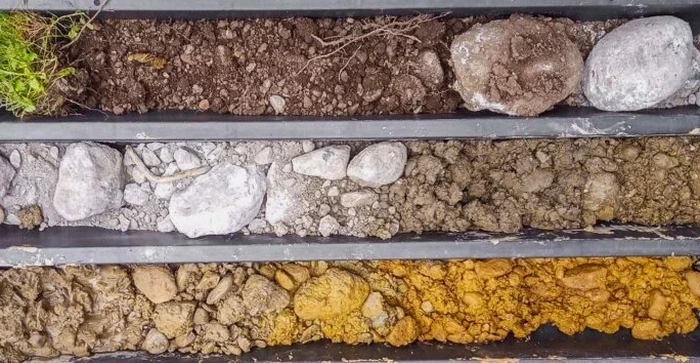
The biggest mistake we see with new construction in Wichita is assuming the soil profile matches what the county soil survey says. The Wellington Formation underlies much of the city, but its weathering profile can shift from stiff shale to fat clay within a single lot. We have pulled exploratory test pits on the west side near the Arkansas River where the top three feet looked like textbook lean clay, only to hit saturated, highly plastic material at four feet that would have wrecked a conventional footing design. When the IBC requires 3,000 psf presumptive bearing but the actual material delivers half that, the schedule and budget blow up. A properly logged test pit lets the geotechnical engineer see the stratigraphy with their own eyes, take undisturbed block samples, and run pocket penetrometer readings right at the excavation face. That direct observation is something no drill rig can replicate, and in a city where the water table can sit just six to eight feet down in the alluvial corridor, seeing groundwater seepage in real time changes the foundation recommendation entirely. We work with local excavator operators who know how to bench safely in the tight access conditions common in older Wichita neighborhoods like Riverside and College Hill.

Direct visual logging of a test pit wall in Wichita's alluvial corridor reveals cross-bedding and perched water that no disturbed sample can capture.
Our service areas

Our approach and scope

Wichita sits at roughly 1,300 feet above sea level on the eastern edge of the Great Plains, and the subsurface here tells a complicated story. The Quaternary alluvium along the Arkansas and Little Arkansas rivers is interbedded with sand lenses and occasional organic silt pockets that standard SPT spoon sampling can smear right through. A test pit exposes those contacts clearly. We log each wall using the ASTM D2487 Unified Soil Classification System, documenting color change, mottling, and oxidation horizons that signal past water table fluctuation. In the deeper pits—typically eight to twelve feet—we can run a nuclear density gauge directly on the bench floor for in-place density verification, or take a drive cylinder for a lab moisture-density curve back at our facility. Where the underlying Ninnescah Shale is shallow and weathers to a stiff red-brown clay, seeing the transition from residual soil to parent rock in cross-section is invaluable for estimating excavation difficulty and shoring requirements. For larger commercial projects near the K-96 corridor, this kind of visual calibration also helps us cross-check CPT soundings and refine the stratigraphic model before the foundation design is locked.
Exploratory Test Pit Investigations in Wichita, Kansas
Technical reference — Wichita

Local considerations

A contractor on a tilt-up warehouse job near 47th Street South called us after the slab-on-grade had already been poured, because the northeast corner had settled two inches in six months. We opened a test pit just outside the footing line and found a buried lenticular silt pocket—maybe twelve feet across and three feet thick—that had consolidated unevenly under fill weight. The original geotech report, based entirely on spaced borings, had missed it entirely. That is the inherent limitation of a one-dimensional boring log: it extrapolates between points. In Wichita's variable alluvial deposits, a lens like that can hide between borings spaced even fifty feet apart. Test pits expose a continuous two-dimensional face, so the engineer sees the lateral extent of soft zones, the dip of sand stringers, and any fill or debris from old farmstead demolition that predates the subdivision. Skipping this step on sites with known variability—particularly east of I-135 where the terrace deposits get chaotic—can mean the difference between a foundation that performs and one that requires expensive underpinning within the first year of service. We have also encountered undocumented abandoned water wells in older parts of town that only a pit excavation revealed before the backhoe found them the hard way.

Need a geotechnical assessment?

Reply within 24h.

Email: [email protected]

Video overview

Reference standards

ASTM D2487 – Standard Practice for Classification of Soils for Engineering Purposes (Unified Soil Classification System), ASTM D6938 – Standard Test Methods for In-Place Density and Water Content of Soil by Nuclear Methods, OSHA 29 CFR 1926 Subpart P – Excavation safety and protective systems (trenching and benching requirements), IBC Chapter 18 – Soils and Foundations (presumptive bearing values and site investigation triggers)

Typical values

ParameterTypical value
Typical excavation depth8 to 12 ft (deeper with benching per OSHA Subpart P)
Soil classification standardASTM D2487 (USCS) with field pocket penetrometer correlation
Sampling methodUndisturbed block samples, drive cylinders, bag samples from each distinct stratum
In-situ density testNuclear gauge (ASTM D6938) or sand cone (ASTM D1556) on pit floor bench
Groundwater observationSeepage rate and stabilized level measured over 24-hour window
Typical access requirement8-ft gate or wider; mini-excavator for restricted Wichita residential lots

Frequently asked questions

What does an exploratory test pit cost in the Wichita area?

For a standard mechanical test pit excavated to 8–12 feet with full logging, sampling, and a site report, the cost in the Wichita metro typically ranges from about US$500 to US$870. The final figure depends on access conditions, number of pits, whether we need a mini-excavator for tight residential lots, and how many lab tests are run on the recovered samples.

How is a test pit different from a soil boring?

A boring gives you a vertical column of disturbed or semi-disturbed material from a single point. A test pit exposes a continuous vertical face, so the engineer sees lateral changes in soil type, contacts between strata, fissures, root penetration, and groundwater seepage patterns directly. You can also take truly undisturbed block samples from a pit, which is difficult with a split-spoon sampler.

How deep can you go with a test pit in Wichita soils?

Practically, we excavate to 8–12 feet with a standard backhoe or excavator. Deeper is possible with benching per OSHA Subpart P, but in Wichita the water table in the alluvial corridor often appears at 6–8 feet, which limits useful depth. In the upland shale areas east of town, we can sometimes go deeper before hitting groundwater or bedrock.

Do I need a test pit if I already have a boring log?

Not always, but on sites with known variability—like the terrace deposits along the Little Arkansas—a single test pit can fill in the gaps between borings. We often recommend at least one pit when the borings show inconsistent blow counts, when fill material is suspected, or when an existing structure has experienced unexplained settlement.

Location and service area

We serve projects in Wichita and surrounding areas. More info.

View larger map