GEOTECHNICAL ENGINEERING
WICHITA
HomeGeophysicsElectrical resistivity / VES (Vertical Electrical Sounding)

Electrical Resistivity Surveys (VES) for Kansas Soil Profiles

Rigorous testing. Clear reporting.

LEARN MORE

The Arkansas River undercuts Wichita's west side with Quaternary alluvium that shifts from coarse sand to tight clay lenses in less than 300 feet laterally. That variability is why contractors and environmental firms in Wichita rely on vertical electrical sounding (VES) before placing monitoring wells or designing retention basins. A four-electrode Schlumberger array lets us map resistivity contrasts down to 120 feet, distinguishing saturated silts from dry, compacted Permian shale. Because the city straddles the Wellington Formation, saltwater intrusion into shallow aquifers is a real concern—VES picks up those conductive plumes where auger refusal stops at cobble layers. We run the survey under ASTM D6431, processing the apparent resistivity curves with 1D inversion software to deliver a layered geoelectric model that ties directly to boring logs and CPT test cone refusal depths along the river corridor.

A 10 ohm-m drop at 20 feet in west Wichita almost always traces back to a perched water table perched atop a clay lens—miss that layer and your infiltration basin fails before the first season.
Our service areas

Our approach and scope

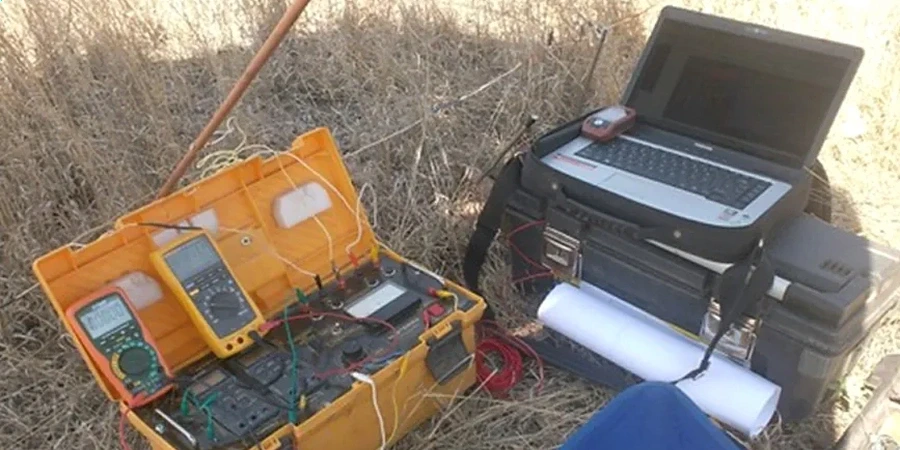
Downtown Wichita sits on stiff, reddish Permian shale that reads 15–40 ohm-m when dry—but east of Rock Road, the Wellington Formation's gypsum beds and thin limestone stringers push bulk resistivity above 80 ohm-m, creating a stark electrical contrast with the west-bank alluvium. That spread means a single VES sounding in Delano can map the transition from sandy overbank deposits into the underlying bedrock at roughly 35 feet, while a sounding near McConnell AFB must sift through thicker clay-rich terrace fills where the resistivity drops below 10 ohm-m. We calibrate each inversion with local boring data to anchor the geoelectric layers to actual grain-size trends, and when the client needs shear-wave velocity for seismic site class, we pair VES with MASW surface-wave profiling along the same transect. Our field crew uses a Syscal Pro switchbox with stainless-steel electrodes spaced at AB/2 increments from 1.5 to 100 meters, recording stacked readings until the coefficient of variation falls under 3 percent.
Electrical Resistivity Surveys (VES) for Kansas Soil Profiles
Technical reference — Wichita

Local considerations

Wichita's post-war expansion pushed residential subdivisions onto the Ninnescah Shale and Wellington Formation, where the contact between weathered claystone and intact bedrock often sits right at footing depth. A 1950s-era basement excavation near Central and West Street recently exposed gypsum dissolution voids that no standard boring grid would have caught—but a resistivity traverse with 5-meter electrode spacing mapped the low-resistivity halo around the void before the backhoe reached it. The Wellington's anhydrite beds create a moving target: fresh groundwater dissolves them slowly, leaving cavities that show up as resistivity highs surrounded by conductive, brine-saturated rims. When a developer skips the geophysical survey and relies only on spaced borings, the risk of differential settlement jumps considerably because the void spacing can be tighter than the boring interval. Our resistivity service in Wichita targets exactly that gap, providing continuous subsurface coverage that auger rigs alone cannot deliver.

Need a geotechnical assessment?

Reply within 24h.

Email: [email protected]

Reference standards

ASTM D6431-18 Standard Guide for Using the Direct Current Resistivity Method for Subsurface Site Characterization, ASCE 7-22 Minimum Design Loads and Associated Criteria for Buildings and Other Structures, IBC 2021 Section 1803 Geotechnical Investigations

Typical values

ParameterTypical value
Maximum investigation depth120 ft (AB/2 = 100 m)
Typical electrode arraySchlumberger (4-electrode)
Measurement range0.1 ohm-m to 100,000 ohm-m
Standard followedASTM D6431-18
Spacing incrementsAB/2: 1.5, 2, 3, 5, 7, 10, 15, 25, 40, 65, 100 m
Data quality thresholdCoefficient of variation < 3%
Inversion method1D smooth-model (Occam) plus layer-based refinement

Frequently asked questions

How deep can a VES survey see in Wichita soils?

With a maximum AB/2 spacing of 100 meters, we can resolve resistivity layers down to about 35 meters (115 feet) in the alluvial and shale formations typical of Sedgwick County. Actual depth of investigation depends on the resistivity contrast and ambient electrical noise, but our Syscal Pro system routinely reaches the top of the Permian bedrock beneath 60 feet of river alluvium on the west side of Wichita.

What does an electrical resistivity survey in Wichita cost?

For a standard single-station VES sounding with 11 spacing increments and 1D inversion, the cost ranges from US$580 to US$1,030 depending on site access, electrode setup time, and whether we need to clear brush or work around buried utilities. A 2D ERT line typically falls in the upper portion of that range per 100 feet of profile because the multi-electrode cable deployment and data processing are more intensive.

Can the survey distinguish between clay and silt?

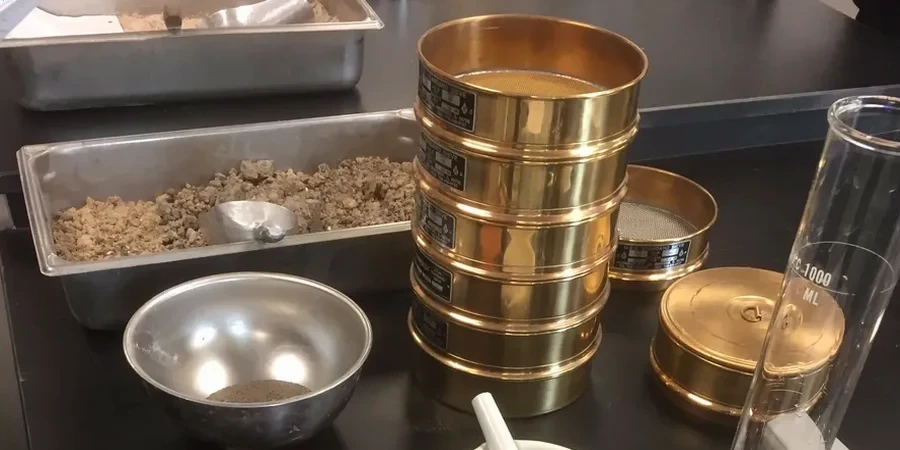
Bulk resistivity alone cannot reliably separate clay from silt because both can read under 30 ohm-m when saturated. What VES does extremely well is identify the depth of the transition from conductive fine-grained material into resistive sand or bedrock. We cross-reference the resistivity curve with a nearby boring log or grain size analysis to assign lithology to each geoelectric layer, which removes the ambiguity.

Do you need to drive electrodes into pavement?

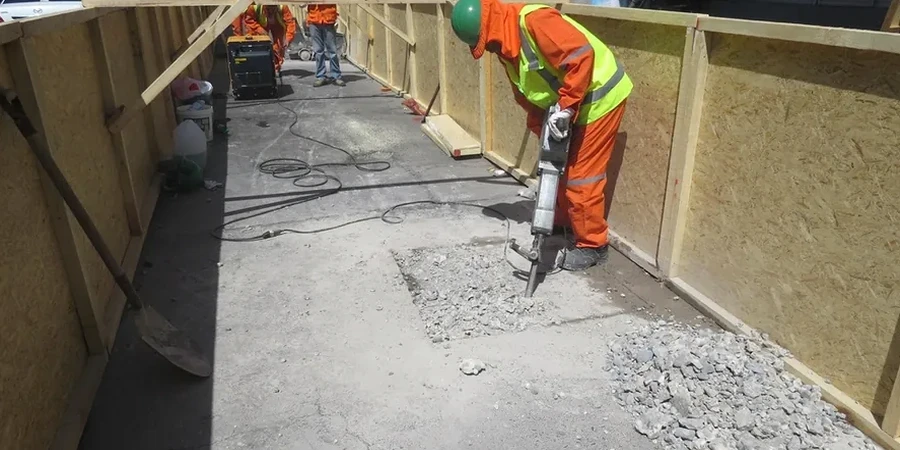
We avoid pavement whenever possible by laying out the array on adjacent grass or gravel. On fully paved sites—common in downtown Wichita—we use small-diameter masonry bits to drill shallow pilot holes through asphalt, then insert the electrodes with conductive gel. The contact resistance goes up slightly, but stacking more readings compensates for the higher noise floor without compromising data quality.

Location and service area

We serve projects in Wichita and surrounding areas.

View larger map